Author Archive

5 Reading Styles That Work

kids magazine subscriptions, reading styles, magazine subscriptions for kids, best kids magazines, best bedtime stories for kids, teaching children to read,Does your child hate bedtime stories? The traditional way to share stories with your children is to sit beside them, book perched on your lap – maybe open across both of your laps – and to read aloud. You put on your best funny voices (or not) and point at key words and pictures. Perhaps you speed up and slow down in all the right places. (We’ve covered traditional reading techniques here.)

But what if the traditional way isn’t working? What if it isn’t holding your child’s attention? Instead of the magical ‘together time’ you’d hoped for, you have a bored, wriggling audience? For some children, being read aloud to – no matter how good you think the story is – can be a monotonous experience. It can feel too passive for an active young mind.

If this is the case, don’t worry and certainly don’t give up. There are other reading styles that might be the key to engaging your child (or children in your class) with reading. In fact, these different styles might help your child develop a lifelong love of stories and books.

At your next Storytime session, why not have a go at these alternative reading styles?

5 Reading Styles to Try Today


1. Fill-in-the-Gaps Reading
This technique works best one-to-one. Simply read aloud as you usually do, but stop every now and again, and ask your child to read out a single word. Start with words you know they’re familiar with to build confidence, before asking them to ‘fill in’ more challenging words or even a few words at a time. Make sure your child feels like they’re helping you to read, rather than being put on the spot. Feeling ‘picked on’ can put them off reading entirely, which is why this technique can be a risky strategy to use in school.

2. Take-it-in-Turns Reading
Reading a book together can be just that, and this reading style works particularly well with more confident readers. Some experts call it ‘see-saw reading’, but the general idea is that you take it in turns to read out sections of a story. You can read alternate sentences, paragraphs or even pages – whatever works best for you. It’s an effective way to keep your audience engaged as they know that their turn is coming soon.

3. Echo Reading
This can take some getting used to and it certainly isn’t for every bedtime story. You’ll also need to ensure you allow enough time for it. The idea is that you read a sentence, and your child reads the same sentence back to you. It might sound repetitive but, by following your lead, your child will unknowingly pick up loads of tips from you on pacing, pronunciation and where to place stress in a sentence. It’s actually a really valuable technique for improving literacy and oracy (that much-overlooked ability to express yourself fluently) and works both at home and in school.

4. Choral Reading
This truly is reading together. Essentially, you read aloud and your child reads along with you at the same time. It’s a lot easier to do with rhymes, short stories and picture books that your child knows and loves. In fact, you probably already do it with fairy tales that have lots of repetition in them (we wrote about the value of repetition in stories here). You don’t have to choral read for a whole story or book, but it’s definitely worth a try for short sections at a time, and it can really help engage young readers and improve pronunciation and reading skills.

5. Picture Reading
This is an interesting and fun approach to try. Ask your child to guess at how a story unfolds simply by looking at the pictures. Use some question prompts to help them along, such as “Who do you think the hero is?”, “Who’s the baddie?”, “What problem does he or she have to solve?”, “What’s happening in this picture?”, “How does it end?”. When your child has finished their picture-only version, read the story together and compare it to the printed version. It’s a sure-fire way to get them engaged with the text.


Parents may also have heard of ‘guided reading’. It’s used in UK schools, where teachers divide children into small groups according to their ability and ask them to decode and understand a text they are reading together. (Rachel Clarke, at Primary Education, has some great advice on guided reading for teachers.)

Previously, we’ve also explored another effective reading style called ‘shared reading’, which you can try at home. Find out more about it here.

kids magazine subscriptions, storytime for schools, free downloads, free teaching resources, reading for pleasure, teaching children to read

Reward good reading with a Storytime certificate!

A passion for getting kids into reading means that educators are always coming up with new reading styles, and there are no hard-and-fast rules on how to carry out them out. You can even try a couple of reading styles in a single Storytime session, or chop and change to suit the mood of your audience.

The most important message is to not give up because reading aloud isn’t working for you. There are always other things you can try. (And, if you want to reward a good reading effort, we have free certificates to download here.)

Let us know if you try any of the different reading styles listed above – and whether they work for you and your child. Or perhaps you have your own reading style that works? We’d love to hear about it. You can get in touch with us via Twitter, Facebook, Instagram, Pinterest or the old-fashioned way!

Before I go, I must give credit to illustrator Rachael Saunders, who created the wonderful circus scene above for Storytime Issue 17.


Enjoy reading stories together this week – that’s the most important thing of all!


The Real Little Red Riding Hood

Little Red Riding Hood, Storytime Magazine, Storytime, Best Bedtime Stories, Kids Magazine Subscriptions,One of the great pleasures of Storytime magazine is that we get the opportunity to dive headfirst into stories and explore their origins. This is especially true of fairy tales, and Little Red Riding Hood was no exception.

kids magazine subscriptions, childrens magazines, best bedtime stories, stories for kids, storytime, little red riding hood

Little Red Riding Hood from Storytime Issue 9, illustrated by Christelle Galloux.

Back in Storytime Issue 9, we featured the most classically recognised version of Little Red Riding Hood. It had wonderful illustrations by Christelle Galloux. (You can still download our adorable Little Red Riding Hood Mask here.) The story is a family favourite and should be in everyone’s fairy tale collection.

But the version that interested me most when researching the original was written in the 1800s. It’s by a French author called Charles Marelles. In his version, the main character’s red riding hood is replaced by a golden one. Not only that, but the hood has a real purpose in the story – other than looking iconic in illustrations. Even better, the main character has a name and a super-cool granny. There’s no male hero to suddenly swoop in and save them at the last minute. I actually think Little Golden Hood is far better and smarter than the ‘original’. It takes all the best-loved bits – particularly the lines children love to read along with – and improves on the source material.

For these reasons, I was really excited to put Little Golden Hood in our latest issue, Storytime 32. We’re also thrilled with the gorgeous illustrations by Martuka, who previously illustrated Little Mermaid for Storytime Issue 24.

For Little Red Riding Hood lovers, I thought I’d share 5 fun facts I’ve gathered along the way. Enjoy!


storytime, children's story magazine, best bedtime stories, little red riding hood, children's magazine subscriptions, gift subscriptions for kids

Little Golden Hood and the wolf, in Storytime Issue 32, illustrated by Martuka.

5 Fun Facts about Little Red Riding Hood


1. This famous fairy tale existed for hundreds of years and across many cultures before it was recorded as a moral ‘stranger danger’ tale by 17th century French author, Charles Perrault. In his terrifying version, Little Red Riding Hood gets into bed with the wolf before he devours her. She doesn’t escape.

2. The French title of Perrault’s story is Le Petit Chaperon Rouge. A chaperon started life as a hooded cape, but evolved into an elaborate and fashionable hat crafted from sumptuous materials like velvet or silk and was worn mainly by men. By the time of this story it had fallen out of fashion and, in a painting from roughly the same period, it looks a bit like a nun’s wimple.

3. In earlier versions from rural France and Italy, the tale was called The Story of Grandmother. There was no red hood and the wolf was actually a werewolf. In some versions, he was an ogre. The little girl has to choose between paths of pins or needles to reach her granny’s house and, when she gets there, granny has been eaten. It’s a pretty gruesome tale, but with an interesting ending – the little girl escapes using her own wit.

4. Far Eastern folklore has its own version of Little Red Riding Hood called Grand Aunt Tiger or Tiger Grandma, but folklorists are now convinced that the story has its roots in the West and was around as long ago as the first century. Folk tale nerds can find out more here.

5. By the time the Brothers Grimm tackled the tale in the 19th century, the red hood had become a cap and the huntsman who saved the day was introduced, cutting open the wolf and freeing his victims with a pair of scissors. As if that wasn’t enough, Little Red Cap fills the wolf’s tummy with heavy rocks to be certain that he dies. Clearly, revenge is best served in a completely over-the-top way!


If you enjoy reading Storytime’s Little Golden Hood, there are many books out there that put a completely new twist on this classic tale and are worth exploring too. For starters, try Alex T. Smith’s witty and wonderful Little Red and the Hungry Lion, sweet and funny Very Little Red Riding Hood by Teresa Heapy and Sue Heap, and the wonderfully graphic Little Red by Bethan Woollvin.

I’d love to hear what you think of our Little Golden Hood version – could it ever replace the ‘original’ or are we just too attached to that iconic red hood? And how do you feel about new twists on classic fairy tales – love or loathe? Let me know on Twitter, Facebook, Instagram, Pinterest and even Youtube, where we post sneak previews of our new issues. Like a good story, we get around!

See you next time for more story ponderings!


Children’s Poetry Winner!

storytime magazine, children's poetry, seahorses, magazine subscriptions for kidsIn September 2016, to celebrate Storytime’s second anniversary, we ran a children’s poetry competition. We hoped to encourage kids everywhere to write a short poem about an animal –real or imaginary. The prize was a bundle of poetry books and having your poem illustrated and published in Storytime magazine.

storytime magazine, children's poetry, kids magazine subscriptions

Bryn with his prize-winning poem, The Seahorses

It was a long wait for the winner, but Storytime Issue 32 came out last week featuring the prize poem: The Seahorses by nine-year-old Bryn Patel Stephens from Leamington Spa in the UK. Here he is, on the right, looking very pleased to have his poetry in print. Deservedly so!

We had no idea when we opened the competition how overwhelming and enthusiastic the response would be. By the closing date in October, we had received thousands of entries from individual children and schools all over the world. They came in from Bangalore to Singapore, Australia to Canada, Germany to Botswana and, of course, the UK, where we are based.

It was with great pleasure that we sat surrounded by piles of children’s poetry. We read our way through many excellent entries, finally whittling them down to a shortlist of ten. In the end, it was our judge – highly esteemed children’s poet, Brian Moses – who helped us pick the winner.

Our Storytime Children’s Poetry Winner

What was is it about Bryn’s poem that made it the winning entry? Bryn conjured up lovely imagery in his description of a ‘constellation of seahorses’. So much so that we could visualise it long before we’d even found the perfect illustrator, Marina Perez.

storytime magazine, kids magazine subscriptions, children's poetry

Bryn’s original entry. Spot the silvery seahorse constellation on the right!

Bryn’s mum, Damyanti, told us that Bryn had gone to great trouble to think up the right kind of adjectives for his poem, and it shows. What also helped was the originality of the subject. Bryn was the only poet to write about seahorses, which made his poem stand out among many cats, dogs, tigers and a fair few unicorns! But, ultimately, Bryn had written a great poem with beautiful descriptions. It was a joy to read and work with.

I’d like to take this opportunity to thank him and all of the amazing schools around the world who took part. Not to mention the inspiring parents who encouraged their children to send in their entries. We truly appreciate the effort.

I’d also like to praise the shortlisted entries who made our children’s poetry competition such a delight to be involved in, though rather tricky to judge! Each shortlisted entry received a special commendation certificate, which they thoroughly deserved. I hope it made the recipients feel proud of their work. In our shortlist, we had monarch butterflies, lions, dragons, dolphins, a mysterious pet, a yaku, a snurkle and even a catasaurusrex. Such brilliant imaginations!

For our third anniversary competition in September 2017, we have another competition coming up – this time celebrating a different area of creativity. I can’t reveal what it is right now, but I feel certain that we’ll get some amazing entries. We’ll update you here on the Storytime blog as soon as we can.

If you missed our children’s poetry competition and want to have fun making up poems, download our free Children’s Poetry Pack. It covers lots of poetry styles and is crammed with ideas and activities to get you started.

We think children’s poetry is not only brilliant fun, but an important gateway to falling in love with language. It’s one of the reasons we have poems in every issue of Storytime. We hope Bryn’s poem inspires you to have a go!


Storytime Issue 32 Is Out Now!

kids magazine subscriptions, Storytime Issue 32, Storytime 32, Pegasus, greek myths for kids, bedtime stories, storytime magazineWhat’s that soaring through the sky? It’s Storytime Issue 32, and it’s landing with UK subscribers this week! (And with international subscribers very soon.) It’s a landmark issue because it’s the first time we’ve had a myth or legend on our cover. In these unicorn-obsessed times, we thought it was fitting to remind everyone of the original and best flying horse. Amazing Pegasus!

storytime magazine, storytime issue 32, kids magazine subscriptions, seahorses, poetry for kids

The Seahorses by Bryn Patel Stephen, aged 9. Illustrated by Marina Perez.

Featuring El Gunto’s magical illustrations, we hope we’ve done Pegasus the Winged Horse and his sidekick Bellerophon justice. It’s a great Greek myth for kids with a memorable three-headed monster, so we hope you enjoy it.

School subscribers also get our fantastic Pegasus lesson plan and resource pack for free. It features lots of themed activities to try out in class. If you’re interested, then find out more on our Schools site. In the meantime, find out what’s inside the rest of the issue here.

Inside Storytime Issue 32

Another highlight of the issue is our prize-winning poem The Seahorses by nine-year-old Bryn Patel Stephens. Bryn entered our Poetry Competition in September 2016 and was selected as the winner by children’s poet Brian Moses. It’s a stunning poem with awesome illustrations to match by Marina Perez

Stanley and the Rampaging Robot by first-time author Stan Byford is guaranteed to make you laugh. Stan grew up building model robots and spaceships, but now makes websites for a living. In his spare time, he invents stories for his son Stanley. This was one of them. It involves a trip to Mars, an out-of-control robot and jam sandwiches. We think you’ll love it. As Stan says, “the illustrations by Marko Renko are amazing and have brought the whole story to life.”

If you think you know the story of Little Red Riding Hood, think again. Little Golden Hood and her granny give the wolf what he deserves in this alternative version with roots in the mid 1800s. It’s an absolute corker.

storytime magazine, storytime issue 32, Little Red Riding Hood, fairytales for kids, magazine subscriptions for kids

Little Golden Hood gets the better of the wolf. Illustration by Martuka.

We are delighted to work with the super-talented Martuka again on this, who illustrated our Little Mermaid cover last summer. (Pick it up from our Back Issue Shop.)

Storytime fans will know that we can’t resist a funny fable. The Cockerel and the Diamond is no exception. It also has the added bonus of being set in a farmyard, which should please little readers. Giovanni Abeille illustrated our chickens with attitude!

No Storytime issue is complete without a trip to Alphabet Zoo. This time we’re joining Bonnie and Boo for a trip to see animals beginning with the letters D and E, including a cheeky elephant. Tim Budgen is our resident illustrator/head zookeeper, as always. Make sure you download our free Alphabet Zoo Factsheet and Activity Packs too. They come with gorgeous animal alphabet posters to collect.

Moscione the Fool is this month’s folktale. Our hero Moscione makes some pretty cool friends on his adventure: Lightning, Quick-Ear, Shoot-Straight and Strong-Back. With their help, he manages to outwit a scheming king! Hopefully, it should make you reconsider the word ‘fool’. Tomasz Plaskowski  provided the gorgeous illustrations for this story.

Finally, our Around the World Tale in Storytime Issue 32 is The Sky Brothers Bring Fire. It’s an Aboriginal myth about the origin of fire. Almost every culture has its own myth about how fire began, so use this story as a starting point for exploring more fire myths. Caroline Attia created the cute koalas and kangaroos in this story.


There you have it, Storytime is packed to the hilt with stories, as ever. Furthermore, we’ve squeezed in drawing, puzzles, book recommendations, a competition and an awesome monster-making game!

Want to flick through the whole issue? Then get a sneak peek here on our YouTube Channel!

We wish you a month of brilliant bedtime stories. We’d love to hear your favourites in Storytime Issue 32. Also, what stories would you like to see in future Storytime issues? Let me know on Twitter or Facebook and we’re also now on Instagram. Do come and say hello!


Happy reading all!


Norse Myths for Kids

norse myths for kids, thor, storytime, kids magazine subscriptions, best magazines for kidsWhen I was growing up, Norse myths were one of my absolute favourite reads. We had an old, old book with a battered cover and dog-eared pages. In the front was a detailed drawing of the mythical tree, Yggdrasil, which I used to study intensely. The idea of a tree connecting different worlds boggled my mind. It was like a much cooler version of Enid Blyton’s The Magic Faraway Tree. As a kid, I couldn’t resist climbing trees, hoping they’d lead somewhere exciting. To this day, I can’t walk past an impressive ancient tree without naming it Yggdrasil.

Not just that, but as an early lover of language and its origins, I was fascinated by the idea that supposedly mythical Norse gods once had enough influence to lend their names to days of the week. Odin (or Woden in Old English) for Wednesday, Thor for Thursday, and Freyja for Friday.

Add to this the humour and cleverness in the original Norse myths, especially from the mischievous trickster Loki (read more about cool tricksters here), and I was won over. My only regret is that the female characters don’t have more starring roles.

Norse Myths in Storytime

norse myths for kids, thor, marvel, storytime magazine, magazine subscriptions for kids

Thor in his wedding gown on the left in Storytime Issue 3! Art by Pauliina Hannuniemi.

So far in Storytime, we’ve featured several Norse myths, including a few Thor stories. Back in Issue 3, one of my favourites, Thor’s Stolen Hammer – in which Thor is tricked by Loki into cross-dressing to retrieve his hammer from the giants. In Storytime 31, Thor ends up duelling with a giant with a stone skull. Odin also makes an appearance on an eight-legged horse. An eight-legged horse, I tell you! I was pleased to see that Marvel put this in their second Thor film. You can also read more of Thor’s adventures and find out how he got his hammer in Storytime Issue 47.

I suppose that brings me to the point of this blog. We hope that Marvel’s Thor films are encouraging more kids to read and enjoy Norse myths. We really do, because it would be a shame if all their knowledge of Thor and his crazy cohorts was limited to what they saw in the movies, as enjoyable as they can be.

Sometimes, you just can’t beat a good story in written form, so we’ll keep putting Norse myths in Storytime, because they deserve a place in our magazine.

We always put a few fun facts and activities in our Myths and Legends section too. However, I thought I’d put a few extra Thor facts here for you to share with your kids. Maybe it will entice them to really get into Norse myths.

5 Fun Facts about Thor

1. Thor had loads of other names, including Atli, which means ‘the terrible’; Ennilang, meaning ‘the one with the wide forehead’ and, coolest of all, Vingthor or ‘Battle Thor’!

Norse myths for kids, Thor, Storytime magazine, magazine subscriptions for kids, best bedtime stories

Awesome art here and top by Tim Paul for Thor’s Duel in Storytime Issue 31!

2. It’s not just Thor’s hammer that has power. Thor also owns a special belt, which doubles his strength, and iron gloves, which he has to wear to handle his hammer.

3. His favourite form of transport was edible! Thor got around in a chariot pulled by two goats called ‘Teeth-snarler’ and ‘Teeth-grinder’. Every now and again, if he got hungry, he ate the goats and then brought them back to life.

4. Thor started a fashion craze – hammer pendants were the in thing among the Vikings, who loved their Norse gods.

5. Thor’s house was the biggest home ever built in Asgard and had 540 rooms! He lived there with his wife Sif and his daughter, Thrud (‘Strength’). He also has two sons called Modi (‘Brave’) and Magni (‘Strong’). There’s a definite theme here…

I reckon a good place to share these facts might be in the middle of the woods, when you’ve found a particularly fine Yggdrasil tree to climb.


If you’ve already got a passion for Norse myths (or myths from any culture), you might want to download our free Myths and Legends Resource Pack, which has loads of great activities and interesting information about myths, legends, gods, heroes and monsters. A grand way to spend your time.


Have a great Thors-day and enjoy sharing the magic of Norse myths with your kids!


Growth Mindset and Reading

Storytime magazine, bedtime stories for kids, kids magazine subscriptions, growth mindset and readingChances are that your child has come home from school in the last year or two talking about growth mindset. It’s a fairly new idea, though it seems to be based on a good dose of common sense, and the great news is that growth mindset and reading – or learning to read – are a match made in heaven.

Find out what a growth mindset actually is and how it could help your child to become a better and more confident reader.

What Is a Mindset?

The growth mindset idea was pioneered by US psychologist, Carol Dweck following decades of research. Dweck says that a mindset is something you firmly believe about yourself. For a child (or adult), this could be “I’m good at reading”, “I’m bad at maths”, “I’m naughty”, or, even worse, “I’m stupid”.

Dweck believes that your mindset – whether you’re aware of it or not – has a profound effect on the way you learn throughout life.

Fixed vs Growth

Someone with a fixed mindset believes that they’re either good at something or they’re not. For instance, good at reading, or bad at maths. They’ll put all their failures and successes down to the talent they were born with and won’t naturally make any effort to develop their skills. You could sum it up as “if you believe you can’t, you can’t.”

Someone with a growth mindset, however, believes that they can develop their skills, get better, and build on the talents they were born with. They’ll be more likely to challenge themselves and will view failures as a chance to learn and improve.

It’s possible to develop a growth mindset from a fixed one, and you can see how this would be far more beneficial to the school environment, and understand why so many teachers are talking about it right now.

Growth Mindset and Reading

One of the ways in which teachers are employing the growth mindset is in the feedback they give to their individual pupils. Instead of saying something is good (or not so good), they’ll praise the effort the pupil has put into working on it and relate that effort to the outcome.

This is something you can adopt at home. Here’s a simple example:

Fixed mindset encouragement: “Great reading.”

Growth mindset encouragement: “You worked so hard to pronounce all those tricky words and look how much better you read tonight and how much more you enjoyed it. Well done.”

The idea here is that your child will make a positive connection between putting in an effort and getting better at reading. From that, they’ll feel inspired and motivated to carry on. More importantly, they might feel more empowered by their own abilities, instead of being held back by a fixed mindset.

Some experts believe that giving growth mindset-style feedback to reluctant readers can be particularly effective. There are some useful and interesting growth mindset feedback examples here for all kinds of scenarios.

Stories for Growth Mindset

Aesop's fables, crow and pitcher, storytime magazine, best bedtime stories, magazine subscriptions for kids

Did the crow in this Aesop’s fable have a growth mindset? Illustration by Erica Salcedo.

Growth mindset is also about sharing good examples to inspire children, and stories can be a fantastic source. I’ve picked just a few from Storytime, which I believe feature positive growth mindset characters.

1. The Hare and the Tortoise (Storytime Issue 1)
You could describe this famous fable as a battle of fixed vs growth mindset. Instead of believing “I’m too slow to race”, the tortoise boldly takes on the challenge and puts itself forward. The tortoise demonstrates growth mindset. The hare, on the other hand, is so arrogant about its own speed, its own fixed mindset causes it to lose the race. “I’m fast, therefore I will win even if I take a nap”. This story is a great example of how growth mindset can bring surprising results.

2. The Mouse Merchant (Storytime Issue 8)
In this inspiring tale from India, a poor but determined boy, with no father and nothing more than a dead mouse to start his career, uses what he has to slowly and successfully build his own empire, one step at a time. A character with a brilliant growth mindset.

3. The Crow and the Pitcher (Storytime Issue 19)
You could also say the clever crow in this fable has a growth mindset. While all the other animals around it are bemoaning the lack of water and awaiting their own demise (“We will die if it doesn’t rain”), the crow seeks ways to survive the drought and comes up with an ingenious solution. It employs a growth mindset to avoid a grisly fate.

4. Moscione the Fool (Storytime Issue 32)
This is an old Italian folk tale about a lazy boy who is considered to be a fool. When he’s forced to go out in the world alone, however, he doesn’t let an “I’m stupid” fixed mindset get in his way. He proves everybody wrong, especially his unsupportive father.


Like all psychological approaches to education, growth mindset has its doubters. Some are wary of how warmly it has been welcomed into schools and wonder whether it oversimplifies individual educational needs, but many argue that they’re seeing evidence of how well it is working.

If you have a struggling or reluctant reader, why not give it a try? Encourage and applaud effort, recognise achievement and give positive examples through stories, books and news articles. There’s even more to growth mindset than that (there are great resources here), but it’s a good start. And if it can help one child stop believing “I’m rubbish at reading”, then surely that’s a positive thing.


Food for thought! See you next time.


Beauty and the Beast: the Real Story

10 things you never knew about Beauty and the Beast, storytime magazine, magazine subscriptions for kidsYou probably haven’t been able to avoid the excitement surrounding Disney’s new Beauty and the Beast, starring Emma Watson. But what do you know of the original story that inspired it?

Like most famous fairy tales given the Disney treatment, it’s hard to imagine that it had a life before Hollywood. Not least a life without singing clocks, candlesticks, teapots, bad guys like Gaston and 3D animation.

But the original story (a version of which is in our latest issue of Storytime) is a different beast indeed. For fairytale fans everywhere, here are 10 things you never knew about Beauty and the Beast.

10 Things You Never Knew about Beauty and the Beast


Beauty and the Beast, Storytime magazine, kids magazine subscriptions

Beauty and her magic mirror in Storytime Issue 31. Illustration by Letizia Rizzo.

1. The original printed version of Beauty and the Beast is credited to a French writer called Gabrielle-Suzanne Barbot de Villeneuve. She included it in a 1740 story collection called The Young American or Tales of the Sea. She claimed that a chambermaid told it to a young lady, while on board a ship to America.

2. Villeneuve’s telling is over one hundred pages long. In it, Beauty is the daughter of a king and a wicked fairy – the very same fairy who turns the prince into a dumb and pitiful Beast.

3. A highlight of Villeneuve’s version include Beauty chatting with birds. She also dreams every night of a dashing prince (who is actually the Beast). Even better, she is able to watch any theatrical performance of her choice through a magic mirror. As this version is from 1740, that’s a pretty cool concept. A wise fairy also visited her in her in dreams.

4. Villeneuve might be most famous for Beauty and the Beast, but in her lifetime, she was best known for her novels. Interestingly, her own story is one of riches to rags. Sadly, she married a man who wasted her family’s fortune and she was widowed at the age of 26. It’s thought she found love later in life with a Parisian playwright.

5. Villeneuve’s story didn’t stay the course. Jeanne-Marie Leprince de Beaumont rewrote it several years later, creating the adaptation we know best today. She also got rid of the rather long ending. Beaumont wrote the story for governesses to share with gifted young girls.

6. In Beaumont’s version, a fairy turns the two mean sisters into statues at the end – statues that are conscious. “You shall stand before your sister’s palace gate, and be it your punishment to behold her happiness; and it will not be in your power to return to your former state, until you own your faults, but I am very much afraid that you will always remain statues,” says the fairy.

7. Neither of the two versions above actually describe how Beast looks, other than saying he is ugly, furry, fierce and frightful. The Beast we imagine today is the creation of clever illustrators, animators and special effects supremos.

8. Anthropologists believe the story is actually over 4,000 years old. Indeed, elements of Beauty and the Beast appear in tales from many different cultures. In Cupid and Psyche (Storytime Issue 17) – a myth from Ancient Rome – Psyche is transported to a magical palace, where she is served by invisible servants and not allowed to see Cupid’s true form. In East of the Sun, West of the Moon (Storytime Issue 2) – an old Norwegian fairy tale – a young girl is taken to a castle hidden in a mountain, served by invisible servants and not allowed to see the bear by night. Also, in The Singing, Springing Lark from the Brothers Grimm, the enchanted prince is disguised as a lion. Perhaps Cupid and Psyche inspired Villeneuve’s tale.

9. Disney weren’t the first to make a Beauty and the Beast film. That accolade belongs to French director, Jean Cocteau, whose 1946 movie is considered to be a romantic, fantasy classic.

10. For some reason, the original French title, La Belle et la Bete, sounds so much more “fairy tale” than Beauty and the Beast, don’t you think?


I love delving into the origins of well-known fairy tales and can’t help thinking there’s an interesting story to be told about Ms Villeneuve. I wonder whether she ever met Beaumont, who was 26 years her junior? Furthermore, what would she have thought of Beaumont’s adaptation? And what would they both think of Disney’s latest reimagining of the story? Would they approve? What do you think?

The story may well be thousands of years old, but like the Brothers Grimm, you have to admire Villeneuve for getting it down on paper and ensuring it would never be forgotten.


Long live fairy tales!


Storytime Issue 31 Is Out Now!

Storytime Issue 31 is out now, magazine subscriptions for kids, kids magazine subscriptions, storytime magazine, best bedtime stories, beauty and the beastNew issue weeks are always the most exciting round here and we’re delighted to say that Storytime Issue 31 is out now – and it’s both a beauty and a beast of an issue!

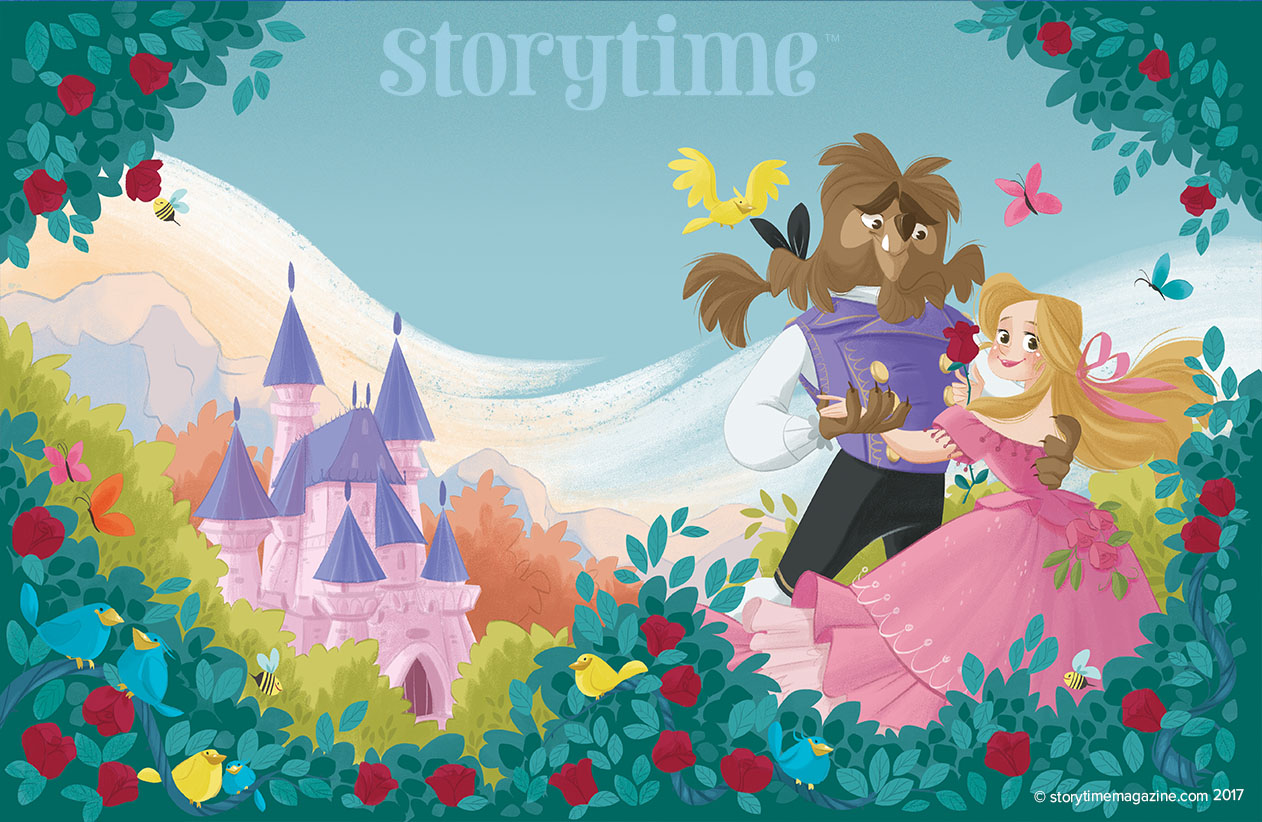
Yes, in light of Disney’s big movie release, we couldn’t miss the opportunity to share with you the original and classic version of Beauty and the Beast. There may not be a singing teapot or candlestick in sight, but there is a great opportunity here to share with your children an amazing tale that is thought to be over 4,000 years old, and which thrived for a long time before Disney put their creative stamp on it. It’s always an interesting exercise to compare the film version with the original, so why not indulge yourself in both? Our gorgeous cover illustration is by Letitia Rizzo, who has given us a very dashing Beast!

Get the lowdown on our contributors and stories here…

Inside Storytime Issue 31

We’re celebrating spring with a learn-off-by-heart abridgement of William Wordsworth’s Daffodils – a great poem for home and school. In fact, school subscribers get our free Daffodils Resource Pack to use in class. Find out more here! Look out for Silvia Sponza’s very original take on the illustration too.

Norse myth, Thor, Odin, Storytime magazine, kids magazine subscriptions, Storytime Issue 31 is out nowOur popular new strand, Tales from Today, returns with Crocodile’s Silver Suit. It’s a sweet and funny story by new writer Lowri Kirkham. Lowri, a student and mum from North Wales, has been writing for several years. She loves sharing stories with her six-year-old daughter. Starring jungle animals and a roller disco, we think this will be really popular with little ones, especially thanks to Lee Cosgrove’s warm and humorous illustrations.

For a bit of action, we’ve got Thor’s Duel – a cracking tale from Norse mythology, featuring Odin, Thor, a giant with a stone skull and an eight-legged horse! You’d be mad to miss it and  brilliant and Tim Paul‘s slightly bonkers illustrations.

Bickering siblings? Look no further than our Famous Fable, The Foolish Otters, for a great lesson in compromise. In our story, it’s a clever jackal who gets the better of the otters. Berta Sastre provided the wonderfully expressive illustrations .

This issue’s Tale from Around the World comes from South Korea and features The Terrible Tiger, except she’s not really that terrible at all and gets outwitted by a fruit! It turns out that Korea is home to loads of great stories and I hope to feature more of them in future. Illustrator Pham Quang Phuc has created a truly great tiger for us.


St Patrick's Day, leprechaun, irish folk tale, irish stories for kids, storytime magazine, kids magazine subscriptionsOur rhyming Alphabet Zoo series is back again, this time featuring animals beginning with the letter C. Storytime favourite Tim Budgen illustrated this poem. On this trip, you can learn about the cockatoo, coati, capybara, chameleon and camel. Plus, you can download our Alphabet Zoo activity pack and collect our posters. We’ve had loads of downloads so far, so we’ll keep putting them up there for you.

Finally, we’re celebrating St Patrick’s Day with a fantastic, funny story from Ireland – Jack and the Leprechaun. We hope it gives you a chuckle and you enjoy Daby Ihsan‘s illustrations, which have a rich, retro feel. Farmer Jack in this story reminds me of a well-known Northern comedian. Let me know if you can spot who. We might just have to share it with him on Twitter.

We hope you enjoy Storytime Issue 31. We are always happy to hear what you think on Twitter or Facebook, and don’t forget that we’re on Pinterest too.


Happy reading!


How To Do Bedtime Stories

how to do bedtime stories, kids magazine subscriptions, storytime magazine, kids magazine subscriptions, best bedtime storiesAnyone who follows Storytime will know that our magazine is built on a deep love of bedtime stories. If there’s one thing our whole team treasures, it’s the memory of bedtime stories as a child. Back then, bedtime stories were a pleasant indulgence – a bit of together time at the end of a busy day. But now, there’s compelling evidence that bedtime stories are hugely beneficial to your children on many levels (see below). But how to do bedtime stories like a pro?

You’ll be surprised by how often we get asked for advice by our readers and parents who are unsure about how to do bedtime stories successfully. Read on for our advice on the when, why, what and how of bedtime stories.

1. When Should I Start Reading Bedtime Stories To My Child?

Kids magazine subscriptions, storytime magazine, how to do bedtime stories, best bedtime stories, magazine subscriptions for kids

Illustration from Storytime Issue 3, Bedtime in Summer, by Amber Cassidy.

Truthfully, it’s never too early to start reading to your child. In fact, the sooner the better. It’s thought that reading to your child from an early age can help them to develop sound recognition, which in turn helps to boost language skills and broaden your child’s vocabulary. And the earlier you start doing it, the more likely it is your child will think of reading as a positive and enjoyable experience. Plus, reading bedtime stories is a great way to bond with your baby.

If your baby is sitting on your lap, begin with board, fabric and sturdy picture books with bold, high-contrast images, mirrors and textures. Newborns will appreciate being close to you and hearing your voice; by six months, they’re a bit more interactive and can make out the shapes, colours and faces in books; by 12 months, they’re touching books, putting them in their mouths and following your finger as you point out pictures.

If you’re reading to a newborn or a baby in a cot (i.e. a baby that won’t grab and tear), you can pretty much read anything you think is appropriate, even bits of your favourite books from childhood. Just hearing you read bedtime stories is a positive thing.

2. When Is The Best Time To Read Bedtime Stories?

We’ve talked before about the importance of timing when it comes to reading bedtime stories, but the best guide of all is your own child. If they’re exhausted after bath-time and can barely keep their eyes open once they’re in pyjamas, it’s not wise to keep them awake any longer with a bedtime story.

Remember: one of the key benefits of a bedtime story (apart from sharing quality time together and all the developmental bonuses it brings) is to ease your child into a relaxed and happy state before drifting off to sleep. You need to share bedtime stories when your child is receptive enough to enjoy them. That could be before bath-time, before pyjamas, after pyjamas, in your special ‘story chair’ or tucked up in bed – only you can truly judge it. And, if you’re not sure, the best advice is to keep trying until you find a time that works for everyone. The main thing is that you commit to doing that.

3. How Many Bedtime Stories Should I Read?

This largely depends on the age of your children – and experts often look at the length of time you read, rather than the number of books. In the UK, the reading charity Booktrust recommends that you aim for 10 minutes of reading every day. In the USA, it’s a minimum of 15 minutes. We say, aim for 10 minutes when your children are very little and gradually increase the time as they get older, aiming for 20 to 30 minutes.

This could equate to one picture book or short story initially, increasing to two or three when they’re a bit older, or a chapter of a book for older children (two or three chapters if it’s an early reader book with lots of pictures). As your children get older, be sure to bring forward your bedtime story slot, so you can fit it in. And keep an eye on the time – it’s easy to keep going or re-reading the same book over and over again when you’re both loving it. It’s great to do this every now and again, but not if it leads to kids associating bedtime stories with sleep deprivation. If you’re really having fun, slot in extra reading sessions earlier in the day or at the weekend. You don’t have to make bedtime stories a mammoth reading session.

4. How Do I Read Bedtime Stories?

With enthusiasm, with pleasure and, most importantly, with everything that makes you who you are. The key to how to do bedtime stories is to be yourself, even if that means stumbling and tripping over words and avoiding silly voices. You’re not a Hollywood actor; you’re a parent. Read our 5 top tips for reading stories for more advice.

5. What Are The Best Bedtime Stories?

In an ideal world, the best bedtime stories are the ones you both enjoy, but you’ll inevitably find that your child falls in love with a book or story you can’t stand. The best advice here is to grin and bear it – and try to see it from your child’s point of view. Try to understand what it is about the story they love so much. If you can work it out, you might eventually be able to lead them to another similar book or story that doesn’t drive you quite as mad.

The best bedtime stories for children tend to have the following themes:

    • They’re funny or downright silly.
    • They feature fears, problems or subjects children can relate to, such as being scared of monsters under the bed, learning to share, being brave, being naughty, starting school, or even disliking vegetables.
    • They star favourite characters, like pirates, dinosaurs and animals.
    • They allow kids to explore imaginary places or other worlds, such as outer space or under the sea.

They’re tried and trusted classics, like fairy tales.

That’s not a comprehensive list, by any means, but it’s a good starting point if you’re stuck and looking for good bedtime stories. You can get recommendations for specific titles over at LoveReading4Kids, sorted by age group.

In Storytime, we try to have several of the above in every issue, of course!

6. What Age Should I Stop Reading Bedtime Stories?

kids magazine subscriptions, storytime magazine, magazine subscriptions for kids, how to do bedtime stories, best bedtime stories

You’re never too old for bedtime stories. Cupid and Psyche artwork for Storytime Issue 17 by Myrtille.

We once attended a talk with children’s author Frank Cottrell Boyce, who claimed that he was still reading stories to his teenage son. That just about sums it up. There’s no cut-off point for reading to your child. No damage can be done by reading to them after a certain age, though there is evidence that stopping too early might have an adverse effect on children’s literacy levels.

As long as your child enjoys it, there’s no reason to stop, and the longer you carry on reading bedtime stories, the more reading tips and strategies they’ll pick up from you. By doing nothing more than reading, you’re teaching them about tone, expression, creating tension, pronunciation, and sharing new words. They’re learning without trying. As they become more competent readers, you can even alternate reading chapters to each other. And, as they get older still, you can introduce them to more challenging texts to really stretch them. What’s more, you can use your bedtime stories as a springboard for all kinds of discussions or activities beyond the book or story. Read for as long as you can and enjoy it.

7. Why Are Bedtime Stories Important?

Bedtime stories are crucial for all of the reasons listed above, but we’ll give you a quick summary of their key benefits. Here are 12 reasons why bedtime stories are important:

  1. They give you a uniquely special ‘together time’ as a family.
  2. They leave your children with happy childhood memories.
  3. They help develop early language skills.
  4. They boost vocabulary at all age levels.
  5. They improve literacy rates in children.
  6. They help kids fall in love with reading – something that lasts a lifetime.
  7. They expand minds and horizons, and explore difference.
  8. They promote imaginative thinking and creativity.
  9. They teach children positive values.
  10. They give children characters or situations they can relate to and learn from.
  11. They foster a greater understanding of the world and other people’s needs.
  12. They bring happiness and laughter.

We’re sure you can think of many more reasons to add to this list.


We hope we’ve answered your questions and have given you a thorough guide to how to do bedtime stories. There are few things in the world that give so many positive benefits, but take so little effort and are so enjoyable to do.

If you’re tackling bedtime stories for the first time, we’d love to hear how you’re getting on – and if you have any more questions, let us know and we can try to share more tips here. Share them with us on Twitter or Facebook – always happy to hear from you!


Best of luck with the bedtime routine!


Inspiring Courage in Kids

kids magazine subscriptions, magazine subscriptions for kids, courage in kids, emperor's new clothesOne of the reasons we place so much value on stories at Storytime is because they inspire so many important and positive reactions in children – curiosity, wonder, inspiration, understanding, empathy and courage. These last two are so crucial right now.

The Most Courageous Kid of All

The Emperor’s New Clothes in our latest issue, Storytime 30, is a brilliant story for inspiring courage in kids, because the real star of the story is not the vain and proud emperor, or the pandering fools around him, or even the tricksters who better him, it’s the small boy in the crowd who’s the only person brave enough to stand up and say, “But he hasn’t got anything on!”

In this case, courage isn’t about wielding a sword and slaying dragons, it’s about having the heart and the nerve to stand up and say what you truly believe in when everyone around you is saying the opposite thing. In The Emperor’s New Clothes, only a child is bold enough to point out the glaringly obvious and embarrassing truth.

This child is probably my favourite in all of the fairy tales we’ve featured so far and, I think, he’s a character that kids can readily identify with. Perhaps adults too – wouldn’t we all like to think we’d be this child in the same situation? (Wait‚ aren’t we in a similar situation right now?)

Tact and good manners are all well and good, but I often wonder whether they’re sometimes at the cost of honesty and courage.

Questions of Courage

I think it’s a pity the child is such a minor character in the story and he’s definitely worth exploring some more. Here are some questions you could consider with your child:

  • Why do you think the boy said what he did?
  • Do you think he was right to say it?
  • What happened to the boy after the emperor’s parade?
  • What did he become when he grew up?

You could even write your own stories about his adventures – and give him a name. He deserves a name.

More Courageous Kids

And while we’re on the subject of courage, here are some more gutsy kids who can teach us some lessons in fearlessness.


Courage in kids, kids magazine subscriptions, magazine subscriptions for kids, best bedtime stories for kids

Gerda is undeterred by the icy Snow Queen. Art by Valeria doCampo.

1. Gerda in The Snow Queen This little girl sets off on her own, undertakes an epic journey, overcomes a brutal band of robbers and remains undaunted by the icy Snow Queen – all to save her best friend. An inspiration. (Storytime Issue 4)

2. Alice in Wonderland In a surreal and sometimes threatening new world, Alice gives the ridiculous and the unjust short shrift and says what she thinks. (Storytime Issue 1)

3. Hansel and Gretel Hansel has the audacity to trick the cannibalistic witch with a skinny chicken bone when she comes to see how well he’s fattening up, and Gretel gives the witch the big heave-ho into the oven. (Storytime issue 13)

4. The girl in Baba Yaga We named her Irina in Storytime. When Irina’s brother is abducted by Baba Yaga’s black geese, she goes on a mission to save him from Baba Yaga’s scary hut, which stands on chicken legs in the middle of the deep, dark forest. (Storytime Issue 26)


All of these stories are good examples of plucky and daring characters who might, in turn, inspire self-belief and courage in kids. Attributes definitely worth having at the moment. And there are many, many more amazing courageous kids in books, so perhaps the most heroic thing you could do this week is take a trip of the library…

Which courageous literary characters inspired you as a child? Let me know, I’d love to hear from you over on Twitter or Facebook. Hope you like the art for The Emperor’s New Clothes – top of page – it’s by the talented Tel Coelho.

Until next time!