Here at Storytime, we create stories for our readers – and we want all of our readers to find characters that they can identify with in our stories. That’s why we believe that diversity matters. How boring would the world – or our magazine – be if everybody looked, thought and talked the same?
This month, we are honoured to have the second guest editorial of the year by the immensely talented Nick Abadzis. He is, amongst many other things, an award-winning comics creator and graphic novelist. He is currently writing and drawing a new book entitled Skin Trouble, which will deal with issues around diversity and representation. Nick is very passionate about the importance of representation in stories and we are so happy to be able to share his thoughts on the matter in our blog. We believe his work is striking and very relevant in bringing greater awareness to this hugely important topic. (c) Nick Abadzis 2022
Why Diversity Matters: A Guest Editorial?
“Diversity” is a word that is often used to describe humanity. We are indeed “diverse,” in that we are many and myriad. Human beings come in innumerable flavours and that, to me, is a fabulous and beautiful thing. It’s our differences, our self-awareness and our ability to co-operate that make human beings the most powerful animal species to ever walk the surface of this planet. Simultaneously, it’s what makes us so dangerous – to all other life that we share this world with, and to ourselves.
 Every one of us is unique and as different from one another as is every single snowflake that ever fell out of the sky over our heads. And, like snow collectively, we form a vista that, from a distance, makes it difficult to tell one tiny element apart from another. In that sense, we are certainly more alike than unalike.
On our social, interpersonal, microscopic street level, things can be a little messier. Our societies are intricately structured, imperfect systems whose communications and (social) media generally reduce humankind’s organic complexity to simplistic, often binary terms that ignore or bypass nuance.
Nuance is a perceptual language all its own. Nuance, or the awareness of it, is the kind of emotional intelligence that any healthy society should aspire to teach their kids so that their lives will be as deep, rich and layered as their parents know they are capable of being.
Children are the future, and every good parent wants to equip their offspring with the tools they’ll need to cope with life and an ever faster, ever-changing world. Certainly, no-one wants their child to be seen as less than the set of potentials they present to their parents.
The declaration of human rights states that “All human beings are born free and equal in dignity and rights.” However, no matter how sound our foundational philosophies and intentions, however lofty our aspirations, all human societies remain unfair.
For this reason, representation in media – and all forms of human visual language – is of paramount importance.
Human systems nowadays tend to forsake nuance for brevity, difficult-to-digest facts for easily consumable half-truths or indeed, outright falsehoods. Yet life cannot be reduced to the kinds of absolutes that give us easy answers. Difference and sameness, conformity versus openness to other perspectives – it’s never this simple.
There are many reasons for this phenomenon, and I won’t attempt to examine any of them in detail here, but for the purposes of this short exploration into the importance of representation, it’s worth making the point that when any society seeks to reduce things to an ‘us versus them’ scenario, you know you are at the mercy of a very particular kind of storyteller – the powerful liar.
However, there are ways of approaching the contradictions of the world without either fear or the rhetoric of hatred. To fear is childish, to flounder and even glory in the absence of experience. To conquer fear is the courage of the childlike, to assume curiosity and interest over apprehension and suspicion. It’s in children that we find the many and myriad possibilities of humanity.
As children, we have greater capacity to grow and learn than at any other time in our lives. I’ve found that encouraging active mental channels back to my child-self and the innate, innocent curiosity I had back then – rather than any fear – has almost always enabled me to find pathways forward out of the depressing and stressful periods of my life.
It takes a bit of experimentation and experience to figure out how one’s own emotions really work – to not be controlled by them but make them work harmoniously for you in your everyday experience of the world.
As a professional storyteller, there have been many occasions when I have been asked how one teaches a sense of empathy, of connection, sympathy, rapport. Like any worthwhile project, it’s cumulative and ongoing. Stories equip children with information about the world in advance of actual experience.
 Of course, in the realm of storytelling, opposites are useful, as conflict is drama. Good and evil, light and shadow. Left and right, rich and poor, warlike and peaceful, happy and sad. Black and white. Us against Them. Me and the other. Me and Everyone Else.
Tribalism is coded into us, which is why it can be weaponised and used against us. This is why it’s crucial that we teach our children to detect and recognise it and oppose it when it’s being used to manipulate us. Life isn’t black-and-white, or even simply shades of grey – not if we don’t want it to be.
Representation provides nuance. It’s both sophistication and an insurance against division and dehumanisation. Quite apart from that, it gives a child – or the wise adult that they’ll hopefully evolve into – a sense of place in a world that has a greater chance of reaching that aspirational goal of every individual truly being “free and equal in dignity and rights.”
It’s important for any child’s development to see themselves reflected back in the media they encounter. It’s pivotal, for their own imaginative development and evolving senses of empathy and sympathy, to give them the chances to see themselves in others, in fiction, in roles that might inspire them, whether it’s via stories on TV, in film, in literature, in comics, in games, in advertising, in public messaging of any sort. It’s essential for them to be allowed to play out of all sorts of possible roles in their minds (and most parents already know this instinctively).
For all the reasons above, representation is perhaps the most important aspect of all corners of modern storytelling, in whatever creative industry or media spotlight it may occur.
Never before has there been a moment in history when an understanding of difference as a positive has been so crucial. A connection to all our different possible and better selves has never counted like it does now, because it brings about an openness to communication and new ideas that will be essential to our long-term mass survival.
 Representation is one of the basic building blocks of fostering such understanding. Representation creates consideration and connection. Never before has it mattered so much that we foster relationships, awareness and understanding between the different peoples of this Earth.
Racial strife, prejudice, differences of belief and opinion aren’t going to go away if we begin to comprehend and represent the wide variety of this world’s inhabitants better, but it’s a good start. This world may be overheating, but it’s still beautiful, full of ideas, passions, sensory experiences and ways of being and seeing that you (and I) will never enjoy directly.
Living those, through stories, via storytellers, via fiction or via documentaries, diarists and journalists… it all makes the scope of life so much vaster and richer than our day-to-day grinds. I can only thank all those sharers of experience for these gifts, for all that insight. It helps me transcend my own parochialism.
One’s own attitude to and perception of the subjects of representation, diversity and inclusion may depend on multiple factors. What I’ve learned in a lifetime of listening and observing is that not many people actually do live in a vacuum, or honestly want to return to a time when we were hunter-gatherers being paranoid about the tribe in the next valley over. “Fear of the other” is the biggest lie humankind ever sold itself. But myths hold power. They shore up all the old systems and still work as the blinkered control-rhetoric of an elite, selfish few who ensure that things stay as they are.
Language is humankind’s oldest technology, and storytelling and shared information our most powerful tool, which is why we should always exercise it and process it thoughtfully. We all have this gene, this ability for telling stories, so tell them well. Don’t live in a world without imaginative sympathy, without benevolent curiosity.
Representation is one of the most important facets of all storytelling, a versatile lens through which we can view ourselves and extend the range of our knowledge and experience. We are humanity. We contain multitudes, and we can each all live several lifetimes inside of one, if we remain open to those possibilities.
We would like to thank Nick for taking the time to share his perspective with us. We hope you have found it as inspirational and thought-provoking as we did!
You can read more from Nick at his blog: https://www.nickabadzis.com/blog
We also recommend checking out Skin Trouble when it is released – we will be sharing it in our channels too and can’t wait to read it. Younger readers are sure to enjoy his comic Pigs Might Fly, which features spectacular illustrations too. It’s a fun adventure story about Lily Leanchops, who invents a flying machine to take on some wicked warthogs. We love it!

 The Queen Bee is a similarly fantastic tale starring a young prince who sets out to rescue a princess who was turned to stone. To free her he must complete seemingly impossible tasks or be turned to stone himself. Luckily, he had previously been kind and cared for a few creatures on the way there, who in return will help him in his quest. This tale, featuring art by the amazing
 One of the most significant ways that we can care for ourselves and others, of course, is by taking care of our environment. This makes sense, as it affects us all! There have certainly been a lot of stories set after an apocalyptic disaster – but we have been thinking about how to create a ‘positive’ future instead for some time… what if we cared for the world now, and managed to build up a better future?
 This month’s fable has a similar theme of caring for the environment that cares for us. In Planting the Seeds, the greedy fox chews up the cores of the apples he eats, while the conscientious squirrel plants them – and reaps the rewards.
 Of course, we couldn’t forget the importance of caring for those who do so much for us! Master illustrator
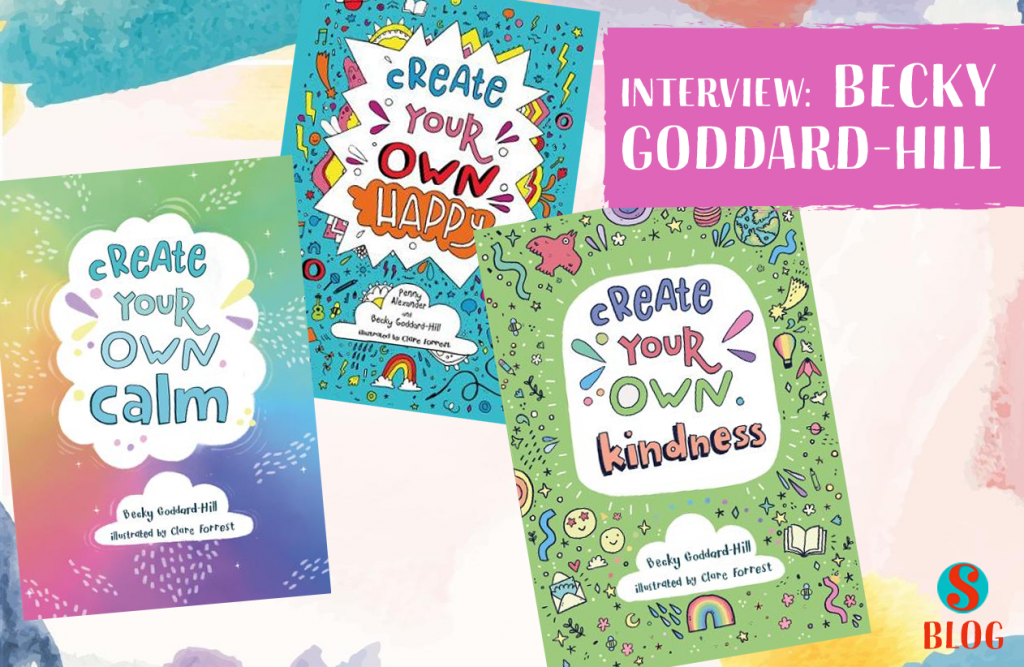
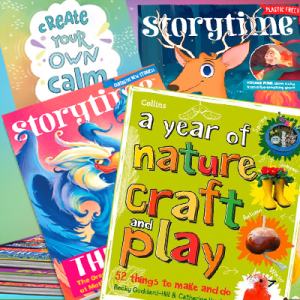 Storytime: Your books encourage creativity and interaction with nature. What role do you think they can play in nurturing children’s mental health?
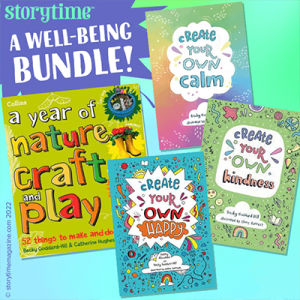 Storytime: We are very happy to be sharing the “Create your own…” series bundle with our readers this month. They highlight calm, happiness and kindness as very important emotional concepts. Would you suggest reading them in a particular order?
 Self-kindness

 The Greek myth of The Dragon’s Teeth stars the hero Cadmus, who suffers a grave misfortune. When his sister is kidnapped by a huge white bull, he is thrown out of his home city and sent to a new continent to find her. He almost loses hope, but with determination (and a little divine guidance!) he has the opportunity to make something for himself and founds a mighty city! Perhaps we learn from this that setbacks can sometimes open us up to new possibilities! Check out the illustrations by
 Sometimes, we also have the chance to make a change in our lives just by changing out attitude and acting with kindness. The latest entry in the ‘Short Stories, Sweet Dreams’ series, illustrated as always by the extremely talented
 We love learning new riddles here at Storytime – and Huckleberry is an American fairy tale about a gnome who is keen to tell people his new riddle – but he hasn’t bothered to come up with an answer! Luckily, a clever shepherdess is able to answer them all! A reminder that admitting that we don’t know something gives us a chance to find out new things! The awesome
 And finally, a little nod to Pancake Day coming up soon! Our folk tale The Runaway Pancake is about “someone” who do not like to miss out on opportunities! The cheeky treat jumps out of a frying pan and runs away from a mother, her seven kids, a grandfather and many others in a madcap chase across town!

 In that sense, we are all experts. We all know what we like. We might not all know when we are being lied to, but we do know when we are intrigued or entertained by a story. We all have an instinct for storytelling. There is no greater truism than, “It’s the way you tell ‘em,” whether it’s a politician on TV selling an idea, a dramatist convincing a producer to put on her play or simply a parent telling their child a good bedtime story.
 One of the questions that professionals will tell you they regularly get asked is, “Where do you get your ideas from?” It’s a question that’s often derided as banal, daft, simplistic. It is, however, a question that articulates the basic uncertainty and curiosity that lies at the root of all storytelling, whether poor, good or great.

 One person who worked hard to overcome challenges and become a great inspiration to all is an amazing woman called Temple Grandin. She became a scientist, cattle-pen designer and an autism advocate who helped many people to understand the condition. Our Awesome Adventures this month, Temple Opens the Door, is about her childhood and her unique way of looking at the world, and artist
 A new year is also an opportunity to follow our dreams, and many characters in our fairy tale do just that! A wee lad called Elias sells his house so he can learn to play the violin – he is soon making beautiful music, and is joined on his journeys across South America by a parade of dancing animals. The story has an unexpected and happy ending which we won’t spoil here!
 One skill that is always great to share with others is cooking! That is the theme of Mrs Valencia and the Paella, a fabulous tale by Canadian author Maria Antonia. When her mum is away on business, little Claudia goes to stay with her Spanish neighbour, who teaches her how to make a tasty new dish!
 But to complete the issue, we thought we would throw a circular tale that reminds us to have fun and laugh! Munachar and Manachar is a rollicking ‘shaggy dog’ story about grumpy Munachar and his complicated plan to punish his berry-stealing friend. This is a great tale to read with someone else – while enjoying

 There is more to self-care than allowing ourselves a treat every now and then. It is about maintaining daily habits that of protect and promote our own happiness, health and well-being – particularly during stressful and busy times.
 Self-care can include acts of giving to others; my passion as a wellbeing writer was borne from the limited ways in which I could practice self-care during the first lockdown. However, I should note that if the act of giving becomes part of your stress and pressure, then it is no longer in the service of your own wellbeing.
 Remember, practicing good self-care will have a positive effect on your children. They can learn how important it is to take action to care about and look after themselves in positive ways too. In ‘My Mind Matters!’ this month, we have introduced the topic of self-care to your children and linked it with the festive period as well.

 This issue’s fairy tale is something special – and not only because
 Another special friendship is the focus of Audun and the Bear, a beautiful tale from Iceland. As you might guess, the young hero befriends a bear and goes on an adventure and makes his fortune. But in the end he realises that what he really wants to do is see his mother again, and returns home with gifts and stories to share.
 Let’s not forget how loved ones can inspire and bring out the best in us! The Great Genies of Angria and Gondal is about some siblings who share some toy soldiers and then make up amazing stories about them. This is a true story about the Bronte sisters and their brother, and it shows how valuable sharing and encouraging each other can be. Though they started out by writing about their soldiers, Anne, Charlotte and Emily would go on to create some of the most famous novels ever written!
 Lastly, we have a fable about a character who doesn’t appreciate those around them as much but are stuck together! The Fir tree learns a humble lesson in the end however. The very talented

 We’ll be working with local publishers, Muse Future, who will be adapting and translating our content into Chinese, but the stories and activities will remain largely the same. Though we have always included Chinese stories in Storytime because it is such a culturally rich place, our partners are also interested in the high quality of illustrations, the diversity of the content and stories from other cultures, in particular our real-life tales and fairy tales too.
 Ji Rongchang, Editor in Chief & CEO of Muse Future Ltd had this to say
 ‘The Monkey King’ (
 ‘Shadow Puppets’ (

 In fairy stories, magical beings often use spells to transform others – and that is what happens in The Enchanted Stag. The deer of the title is actually a boy who is ensorcelled by a wicked witch. Don’t worry – it has a happy ending and the wee boy isn’t the only one who is transformed!
 In Pele and the Poi, the hot-tempered Hawaiian volcano goddess use her magic on herself! She wants to find out more about her human neighbours, so she changes into an old lady and pays them a visit!
 Of course, music can also put a spell on us. In The Adventures of Young Finn, a fire-breathing giant puts a whole city to sleep with a tune played on an enchanted harp! Luckily for the inhabitants, though, a brave Irish boy with a sorcerous spear is on hand to save the day. We think that
 And finally, we have something a bit special for this month’s Tales from Today, The Grand Royal Minibeast Hotel by author